

What Is SEO Performance?
 SEO performance is the measure of how well a website supports search visibility, qualified traffic, and meaningful business outcomes through organic search.
It is not only about where a page appears in the search engine results page. Rankings matter, but they are only one part of the larger picture. Strong SEO performance also includes how clearly the website is structured, how well the content matches search intent, how easily search engines can crawl and understand the site, and whether visitors can move toward a useful next step.
For a service-based business, SEO performance should connect directly to business growth. The real question is not simply, “Are we getting more traffic?” The better question is, “Are the right people finding the right pages, understanding the offer, and taking action?”
That is why search engine optimization needs to be viewed as a system. Technical SEO, keyword research, content optimization, on-page SEO, local SEO, website performance, internal linking, and measurement all need to work together. When they are disconnected, the website may still receive traffic, but it may not create qualified leads or clear customer acquisition.
At iNDEXseo, SEO performance means the website is becoming easier to find, easier to understand, easier to measure, and more useful to the people the business is trying to reach.
Why SEO Performance Often Feels Unclear
Many business owners know their website should be doing more, but they are not always sure what is holding it back.
The site may look professional. Content may already exist. Some pages may rank for certain keywords. Yet the business may still feel uncertain about whether the website is truly supporting lead generation.
A website can appear active without clearly showing whether visitors are finding what they need. Google Search Console helps reveal how people discover the site, which search terms bring them there, and which pages are gaining visibility. Google Analytics helps show what happens next, including whether visitors stay engaged, move through the site, and take meaningful action. Together, these tools help turn website activity into clearer performance insight.
This uncertainty often arises when SEO activity lacks a clear structure.
A business may update meta tags, publish SEO writing, add service pages, improve mobile optimization, or work on link building, but those actions may not be connected to a larger SEO strategy. Some changes may help. Others may have little impact. Without proper SEO performance analysis, it becomes difficult to know what is working, what is not working, and what should happen next.
Poor SEO performance is not always caused by one major issue. It is often the result of several smaller issues working together. A website may have thin content, unclear page structure, weak internal links, broken links, duplicate topics, slow page speed, missing schema, weak local SEO signals, or pages that do not fully match search intent.
That is why a structured SEO audit is so important. Before a business can improve its website’s SEO performance, it needs to understand the website’s current condition.
How SEO Performance Is Built
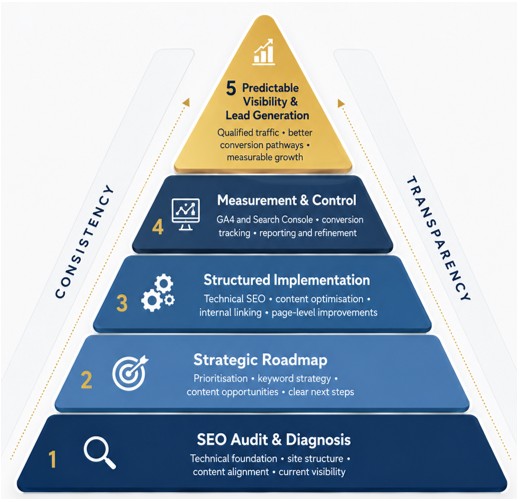
The Pyramid of SEO Performance provides a simple framework for understanding how sustainable SEO performance develops.
Instead of starting with random tactics, the pyramid begins with diagnosis. Each layer supports the next layer. This creates a clear path from website review to strategic direction, structured implementation, measurement, and improved business outcomes.
The pyramid has five layers: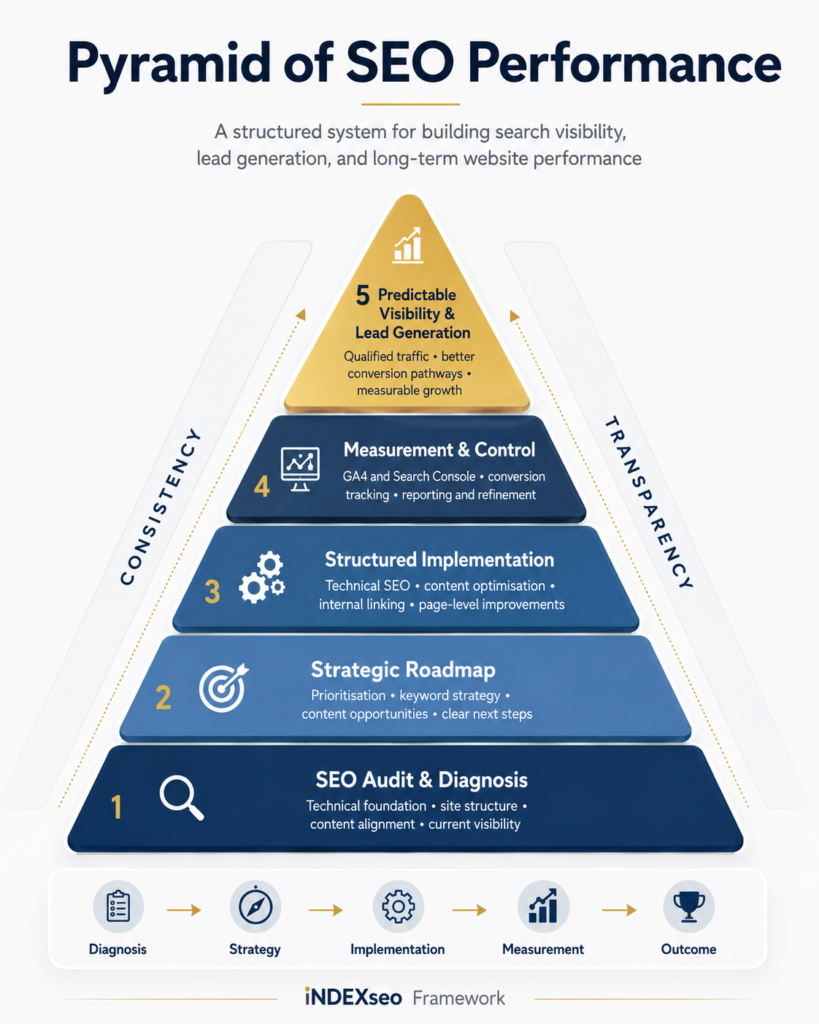
- SEO Audit & Diagnosis
- Strategic Roadmap
- Structured Implementation
- Measurement & Control
- Predictable Visibility & Lead Generation
The foundation is the SEO audit. This is where technical SEO performance, website structure, content alignment, search visibility, and current rankings are reviewed. Tools such as Screaming Frog SEO Spider, Google Search Console, Google Analytics, Google Lighthouse, GTmetrix, and other SEO analysis tools can help identify technical and content-related issues.
The second layer is the strategic roadmap. This is where findings are organized into priorities. Not every issue carries the same business impact. A proper SEO audit report should separate urgent technical problems from longer-term content opportunities, local SEO improvements, link building considerations, and on-page SEO refinements.
The third layer is a structured implementation. This is where SEO recommendations become practical action. Technical fixes, content optimization, keyword mapping, mobile-friendly improvements, Core Web Vitals refinements, internal linking, meta tags, service page improvements, and conversion pathways are addressed in the right sequence.
The fourth layer is measurement and control. SEO performance monitoring gives the business a way to track what is changing over time. This includes SEO performance metrics, KPI tracking, keyword movement, organic search results, SERP visibility, content performance, bounce rate, conversion data, and lead activity.
The top of the pyramid is the outcome: predictable visibility and lead generation. This does not mean guaranteed rankings or instant results. It means the business has a clearer system for improving search visibility, understanding performance, and making better decisions over time.
How to Measure SEO Performance
To properly measure SEO performance, a business needs to look beyond the numbers.
Traffic alone is not enough. Rankings alone are not enough. A website can gain impressions without clicks, clicks without inquiries, and inquiries that do not match the right customer profile. Good measurement looks at the full path from search visibility to business outcome.
Important SEO key performance indicators may include organic impressions, organic clicks, click-through rate, keyword movement, indexed pages, Core Web Vitals, mobile usability, local SEO visibility, engagement, conversions, and qualified leads.
Google Search Console helps show how the website appears in organic search results. It can reveal which search queries are gaining impressions, which pages are receiving clicks, where average positions are changing, and whether important pages are being discovered by Google.
Google Analytics helps show what visitors do after they arrive. It can help measure engagement, traffic quality, conversion paths, form submissions, phone clicks, and other actions that matter to the business.
For local service businesses, Google Business Profile performance also matters. Local SEO performance may involve visibility in map results, calls, website clicks, direction requests, and service-area search behaviour.
SEO reporting dashboard
SEO reporting should bring these signals together in a way that supports decision-making. A good SEO performance dashboard should not overwhelm the business owner with disconnected data. It should answer practical questions:
- Are the right pages becoming more visible?
- Are qualified visitors taking action?
- Are technical issues being reduced?
- Are content and service pages supporting search intent?
- Are SEO improvements contributing to measurable business outcomes?
When measurement is clear, SEO becomes easier to manage.
How to Improve Website SEO Performance
To improve website SEO performance, the first step is to identify which part of the system is limiting results.
Some websites need technical improvements. Others need clearer service pages. Some need stronger keyword research and content optimization. Others need better local SEO, internal linking, authority signals, or conversion tracking. In many cases, the answer is a combination of several areas.
Technical SEO should confirm that search engines can crawl, index, and understand the website. This includes site structure, page speed, Core Web Vitals, mobile optimization, redirects, broken links, canonical tags, XML sitemaps, robots.txt, structured data, and overall website performance.
On-page SEO should make each important page clearer. This includes the page title, meta tags, headings, service descriptions, internal links, image alt text, search intent alignment, and the relationship between the page content and the business offer.
Content optimization should strengthen the connection between what people search for and what the business provides. This does not mean adding keywords for the sake of adding keywords. It means using keyword research to understand demand, then building useful content that reflects the business owner’s real expertise.
Local SEO should help service-area businesses become more visible in the markets they serve. This may include Google Business Profile optimization, location signals, service-area content, reviews, citations, and locally relevant landing pages.
Off-page SEO and link building can also support authority, but they should not be treated as a shortcut. Links are strongest when they support a website that already has a sound technical foundation, useful content, and clear positioning.
The best SEO performance improvements usually come from disciplined sequencing. Fix the foundation first. Clarify the strategy. Implement with structure. Measure what changes. Then refine.
Why Diagnosis Comes Before Implementation
Many SEO projects struggle because they begin with action before diagnosis.
A business may ask for more content, better rankings, new service pages, or a stronger local SEO presence. Those may be valid goals, but without a proper review, it is difficult to know which actions should come first.
Diagnosis protects the business from wasted effort.
A technical SEO audit can show whether pages are being blocked, duplicated, redirected, poorly structured, or slowed down by performance issues. A content audit can show whether pages are thin, unclear, overlapping, or misaligned with search intent. A keyword and SERP review can show whether the website is targeting the right opportunities. A conversion review can show whether visitors have a clear path to take the next step.
This matters because SEO is not just a marketing task. It is part of the business infrastructure.
If the foundation is weak, more activity may not create better results. More content may create more confusion. More pages may create keyword overlap. More traffic may not create more qualified leads. More reporting may create more noise instead of better decisions.
Diagnosis creates clarity. Clarity creates better prioritization. Better prioritization leads to stronger implementation.
That is the purpose of the Pyramid of SEO Performance. It slows the process down at the right point so the business can move forward with more confidence.
Next Step: Start With an SEO Performance Audit
If your website performance feels unclear, the next step is not to guess at another tactic.
The right next step is to check your website SEO performance through a structured SEO audit.
An SEO performance audit helps identify what is helping, what is hurting, and what should happen next. It reviews the technical foundation, website structure, content alignment, search visibility, on-page SEO, local SEO signals, website performance, and measurement setup.
From there, the work can move into a practical roadmap. The roadmap defines priorities, clarifies implementation steps, and connects SEO activity to measurable outcomes such as qualified traffic, better conversion pathways, and lead generation.
This is where iNDEXseo helps.
iNDEXseo works with business owners to translate their expertise into discoverability, structure that expertise for search visibility, and connect website improvements to measurable business growth.
SEO performance improves when systems, technical structure, content, intent, and trust are properly aligned.
That is the foundation of the Pyramid of SEO Performance.
Start Your SEO Performance Audit
If you want to understand what is limiting your website’s visibility, begin with a structured review of your technical foundation, content alignment, and search performance. Then build the roadmap from there.